
What Is a CRP Test: Decoding Inflammation Markers in Your Blood Report
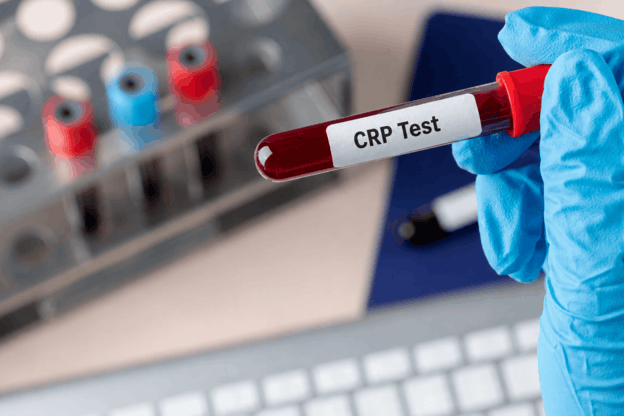
A C-reactive protein (CRP) test is a simple and common blood test used to identify inflammation in the body. The article discusses different aspects of the CRP test.
Table of Contents
ToggleWhat is CRP Blood Test? What Does it Measure?
C-reactive protein (CRP) is a protein released by the liver in reaction to inflammation. A CRP test is often used to identify inflammation in the body. Conditions such as infections, inflammatory diseases, tissue damage, etc. can lead to an increase in CRP. However, it is a non-specific marker because while it indicates the presence of inflammation, it is not useful in identifying its cause or location
When Should You Consider Getting a CRP Test?
A doctor may recommend a CRP test in case any of the patient’s symptoms point to an infection or inflammation, such as a persistent fever, chills, joint pain or swelling, etc.
CRP can be used to track the recovery process following surgery. Additionally, it is also used to evaluate the effectiveness of a treatment against the infection or inflammation. A decrease in CRP levels may suggest that inflammation is falling.
How Is a CRP Blood Test Performed?
One must understand what is CRP test, to not worry about it. It is just a standard blood test. A healthcare professional starts by cleaning the skin. Then inserts a tiny needle into a vein in the arm to draw blood into a tube. Then, the sample is transported to a lab for examination. The procedure takes just a few minutes. In addition, the doctor must be informed if the patient is taking any medications or supplements in case they may have an impact on the test result.
How to Read CRP Test Results in Your Blood Report
Although some labs use milligrams per decilitre (mg/dL), CRP is often reported in milligrams per litre (mg/L).
However, the reference ranges might differ based on different laboratories. A healthy person usually has very low CRP levels. A CRP level below 5 mg/L is considered to be within the normal or low range.
To note:
● Low or normal CRP: Minimal to non-significant systemic inflammation.
● Mild to moderate increase: Few non-infectious diseases, a mild infection, or chronic inflammation.
● Marked elevation: Significant infection, tissue damage, or other major inflammatory processes.
What Causes CRP Levels to Rise?
When there is inflammation, the liver produces more of the protein, resulting in CRP increases.
Common causes include:
● Viral or bacterial infections
● Autoimmune conditions including lupus and rheumatoid arthritis
● Inflammatory bowel conditions
● Trauma or tissue damage
● Certain cancers
● Inflammation or complications post-surgery
● Other inflammatory diseases
CRP levels scan also be affected by other factors, including physiological and lifestyle factors. CRP is an indication, not a diagnosis.
Can a CRP Test Tell You Where the Inflammation Is?
CRP test acts as an indicator for inflammation or infection. It cannot point out the exact location of inflammation. For example, an increased CRP can be a response to inflammation in the lungs, joints, gastrointestinal tract, urinary system, or another part of the body.
Why CRP Results Need to Be Interpreted With Other Tests?
Since a CRP test cannot identify the cause or location of the inflammation, a doctor must combine CRP with symptoms, physical examination findings, medical history, and other investigations like complete blood count, ESR, cultures, imaging, or disease-specific tests when necessary.
Although several inflammatory disorders might cause a very minimal CRP rise, a significant increase might also occur in other unrelated situations. This is a major reason as to why CRP should not be the only factor considered when making treatment decisions.
In certain cases, observing a trend might be more useful than a single outcome. For example, a declining CRP following treatment can indicate that inflammation is becoming better. Also, a constant or increasing number might be concerning.
What Factors Can Affect Your CRP Test Result?
CRP levels can be influenced by several circumstances, such as:
- Recent injury or infection
- Smoking
- Obesity
- Being pregnant
- Hormonal treatment, including certain contraceptives
- Sex and age
- Some chronic inflammatory diseases
- Physical exertion
- Certain medications
A result should always be interpreted in light of the patient’s symptoms and recent medical history because CRP can fluctuate somewhat fast in reaction to inflammation.
Are There Any Risks or Limitations of a CRP Test?
A typical CRP blood test involves the usual minor hazards of blood collection and is generally considered to be safe. These may include light-headedness, bruising, transient discomfort, or, in rare cases, an infection or severe bleeding.
The key issue is interpretation. CRP cannot differentiate between different infections. It is not useful in diagnosing a particular illness or determining the cause of inflammation. Also, it is important to note that a low result does not entail the absence of inflammatory illness.
Standard CRP vs hs-CRP: What Is the Difference?
CRP and hs-CRP tests both measure C-reactive protein, although they are used for different clinical purposes. The high-sensitivity CRP, or hs-CRP, test is used to identify much smaller increases in CRP. While the CRP test is used to detect and monitor inflammation associated with infections, inflammatory diseases, and tissue injury, the hs-CRP test is used to assess cardiovascular risk rather than the diagnosis of acute infections.
The following are the cardiovascular risk categories frequently used for hs-CRP:
- Reduced cardiovascular risk: less than 1 mg/L
- Average cardiovascular risk: 1-3 mg/L
- Elevated cardiovascular risk: more than 3 mg/L
It is necessary to understand that these categories are meant for cardiovascular risk assessment and should not be confused with regular CRP test results intended for an acute illness.
When Should You Discuss a High CRP Result With a Doctor?
We have our answer to what is CRP blood test! Since low CRP protein is the target for a healthy individual, a high CRP test should be discussed with the doctor. A high CRP accompanied by persistent fever, severe or worsening discomfort, unexplained weight loss, breathing difficulties, major exhaustion, etc. is particularly alarming.
A high CRP result is not a direct representation of any specific disease. However, depending on a patient’s clinical scenario, it might require further research. Further investigations like blood tests, cultures, etc. are done by the doctor to figure out what is causing the inflammation.
Frequently Asked Questions
What is a CRP test used for?
It is used to find and monitor inflammation. It can help to check for infections, inflammatory disorders or how well the treatment is working. However, it is not capable of determining the precise source or cause of inflammation.
What is considered a normal CRP level?
Normal CRP levels are usually less than 5.0 mg/L. But different laboratories have different reference ranges.
Does a high CRP always mean an infection?
A high CRP suggests the presence of an infection. However, it could be due to inflammatory illnesses, tissue damage, autoimmune diseases, etc.
Is fasting required for a CRP blood test?
Usually, fasting is not necessary for a conventional CRP test. Your food and liquid consumption can be normal.
Can CRP levels return to normal?
CRP levels may decrease when the underlying inflammation goes away or improves with treatment, CRP levels may decrease.
Can CRP test be an indicator for heart disease?
CRP test levels are not as useful as the hs-CRP test in assessing cardiovascular risk.